








![10 Best Floor Lamp for Reading [2026 Review]](http://www.homebaa.com/cdn/shop/articles/banner_c990b0a4-4743-4902-b6be-5609f7a21a90.webp?v=1766393057&width=400)



![How to Choose the Coffee Table Height? [2026 Newest Guide]](http://www.homebaa.com/cdn/shop/articles/coffee-table-height_2a1fd127-359f-4d5f-9ac1-3b232c7092a9.webp?v=1788166652&width=400)


A console table is one of those pieces of furniture that can seem optional until you place one in the right spot. A blank entry wall gains a useful landing place. The back of a floating sofa looks finished instead of exposed. A narrow hallway becomes a display area without losing much walking space. In each case, the table adds function while taking up less room than a cabinet, desk, or dining table.
So, what is a console table? In modern homes, it is usually a long, relatively narrow accent table designed to stand against a wall or behind a sofa. Most console tables are roughly counter height, although dimensions vary. They may have an open base, shelves, drawers, cabinets, a half-moon top, or a sculptural pedestal. Their main job is to provide a convenient surface and visual anchor where deeper furniture would feel bulky.
The term is broader than “entryway table.” A console can work in a foyer, hallway, living room, dining room, bedroom, or home office. The best choice depends less on the label and more on the dimensions, placement, and purpose.
This guide explains the console table meaning, common uses, typical dimensions, placement rules, material choices, styling methods, and differences between a console table, sofa table, sideboard, coffee table, and end table. It also includes a practical measuring checklist and carefully selected Homebaa collections and products for different spaces.
Quick Jump Links
- Quick Answer: What Is a Console Table?
- What Is a Console Table Used For?
- Console Table vs. Other Tables
- Console Table Dimensions and Measuring
- Common Types of Console Tables
- Choosing the Right Material
- How to Choose a Console Table
- How to Style a Console Table
- Common Console Table Mistakes
- Recommended Homebaa Collections and Products
- Final Buying Checklist
- FAQ
Quick Answer: What Is a Console Table?
A console table is a narrow table commonly positioned against a wall, in an entryway, along a hallway, or behind a sofa. It gives you a raised surface for lighting, décor, and everyday objects while using less floor depth than most full-size storage furniture.
The shape is typically long and rectangular, but that is not a requirement. Half-moon console tables sit neatly against a wall with a rounded front. Sculptural models use curved, circular, or pedestal bases. Storage console tables may include drawers, shelves, or cabinets. Some designs are visually light and open; others function more like compact storage furniture.
Simple definition: A console table is a slim accent table that creates a practical surface and a visual focal point in an area where deeper furniture may not fit.
Historically, early console tables were associated with wall-supported or bracket-supported designs. Today, most are freestanding, although many are still intended to sit close to a wall. Because a modern console can serve several rooms and purposes, the name describes a furniture category rather than one exact construction.
What makes a console table recognizable?
- A narrow profile: It usually projects less into the room than a desk, dresser, or sideboard.
- A raised display surface: The top is convenient for lamps, trays, artwork, flowers, books, and small essentials.
- Flexible placement: It can work against a wall, behind a sofa, beneath a window, or as a subtle room divider.
- Accent-table proportions: It is generally taller than a coffee table and longer than an end table.
- Optional storage: Drawers, shelves, and cabinets are available, but an open console without storage is equally common.
What Is a Console Table Used For?
The most useful answer depends on the room. A console table often fills an awkward stretch of space while adding a surface at a comfortable standing height. It can be decorative, practical, or both.
In an entryway or foyer
An entryway console table creates a natural landing zone near the door. A tray can contain keys, sunglasses, and wallets. A small bowl can hold loose change. Drawers can hide mail, charging cables, gloves, or dog-walking supplies. A mirror above the table gives you a final check before leaving and visually expands a compact foyer.
For a busy entrance, leave a clear area for a bag or package. In a narrow walkway, check that doors, drawers, and nearby closets can open fully.
Behind a sofa
When a sofa floats away from the wall, a console table behind a sofa adds structure, supports lamps or books, and can define the living zone in an open plan.
Behind-sofa placement requires careful height selection. The table should normally be level with or slightly below the highest practical part of the sofa back. A table that rises far above the upholstery can look awkward and may expose cords or the backs of accessories from the seating side.
In a hallway
A hallway table can turn an empty passage into a considered part of the home. Use it for one lamp, a small arrangement, or a few framed photographs. Because circulation is the priority, depth matters more than storage capacity. A narrow console table can be useful, but only if people can still walk comfortably without brushing the edge.
In a living room
Against a living room wall, a console can anchor artwork, fill the space between windows, or sit beneath a wall-mounted television when a media cabinet would be too deep. Do not obstruct ventilation or wiring.
In a dining room
In a dining room, a console can provide a small serving or display surface. If you need substantial enclosed storage for dishes and linens, a sideboard or buffet is usually more practical.
Console Table vs. Sofa Table, Sideboard, Coffee Table, and End Table
Furniture names sometimes overlap because retailers and homeowners describe pieces by both form and location. The comparison below is a practical guide rather than a strict rule.
| Furniture Type | Typical Placement | General Shape and Height | Primary Purpose |
|---|---|---|---|
| Console table | Against a wall, in an entryway or hallway | Long, narrow, and usually about 28–36 inches high | Display, landing surface, light storage, or visual anchoring |
| Sofa table | Directly behind a sofa | Narrow and sized in relation to the sofa back | Finishes the sofa area and supports lamps or décor |
| Sideboard or buffet | Dining room or living room wall | Deeper, heavier, and usually cabinet-based | Substantial storage for dishes, linens, media, or household items |
| Coffee table | In front of a sofa or seating group | Low and designed for seated reach | Drinks, books, remotes, serving, and living-room styling |
| End or side table | Beside a sofa, chair, or bed | Compact and generally close to arm or mattress height | Provides a small personal surface within easy reach |
Is a sofa table the same as a console table?
Often, yes. “Console table” describes the broader category, while “sofa table” describes how the piece is used. A table sold as a console can work behind a sofa if its height, length, depth, and stability suit that placement. A sofa table can later move to an entryway and function as a console.
Is a console table the same as a sideboard?
Usually not. A sideboard is generally deeper and offers more enclosed storage. It has the visual weight of a cabinet and is often designed for dining-room service. A console table is usually slimmer, making it better for hallways, entries, and areas where you want an open or less bulky silhouette.
Console Table Dimensions: Height, Depth, and Length
There is no universal standard size, but common ranges provide a useful starting point. Many console tables stand approximately 28 to 36 inches high, measure around 10 to 16 inches deep, and range from roughly 30 to 72 inches long. Compact, extra-tall, and oversized designs can fall outside these ranges.
Use these numbers only as a starting point. Measure the actual floor area and surrounding furniture before ordering.
How deep should a console table be?
A table around 10 to 12 inches deep can suit a narrow hall. A depth closer to 14 to 16 inches provides more surface area but needs a wider passage. Tape the footprint on the floor and walk past it while carrying a bag.
How high should a console table be?
Relate the height to nearby switches, artwork, windows, and furniture. Behind a sofa, use the sofa back as the main reference instead of a generic console height.
How long should a console table be?
Leave breathing room at both ends. Behind a sofa, a table spanning about one-half to two-thirds of the sofa length is a useful visual starting point, not a mandatory rule.
A five-step measuring method
- Measure the available wall or sofa length. Record nearby door casings, floor vents, radiators, outlets, and switches.
- Measure usable depth. Preserve a comfortable walkway and account for drawer or cabinet-door clearance.
- Check the intended height. Compare it with the sofa back, windowsill, mirror, artwork, and any lamp you plan to use.
- Make a floor template. Painter’s tape or flattened cardboard reveals the footprint more clearly than numbers alone.
- Test the route into the room. Confirm that the packaged or assembled table can pass through doors, stairs, elevators, and tight corners.
Practical clearance tip: Do not judge a hallway by standing still. Walk through the taped outline in both directions, open nearby doors, and carry the types of objects you normally bring through the space.
Common Types of Console Tables
Narrow entryway console table
This is designed for limited-depth spaces. It may be long enough to anchor a wall while remaining only about 10 to 12 inches deep. The best models balance a slim top with a stable base, especially when placed in a busy route near the front door.
Console table with drawers
Drawers are useful for small objects that create visual clutter: keys, mail, chargers, pens, pet supplies, or spare batteries. Check internal drawer dimensions and opening clearance rather than assuming a wide table provides wide storage.
Console table with a shelf
An open lower shelf can hold baskets, books, ceramics, or a pair of decorative boxes. It provides more capacity than an open base while preserving a lighter appearance than a cabinet. Make sure shelf décor does not extend into walking space.
Cabinet-style console
A console with doors behaves like a shallow storage cabinet. It can hide entryway essentials or dining accessories, but it has more visual weight. This style is useful when storage is the main need and the room can support a more substantial piece.
Half-moon or demilune console table
A demilune table has a flat back and curved front. It follows the wall closely and softens a room filled with rectangular furniture. The rounded edge can also feel less intrusive in a compact foyer, although its usable surface is often smaller than that of a rectangle with the same overall width.
Sculptural or pedestal console table
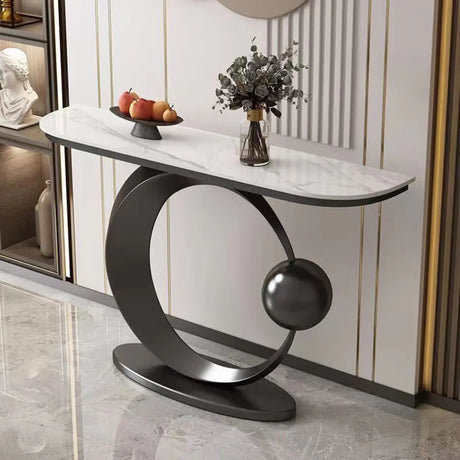
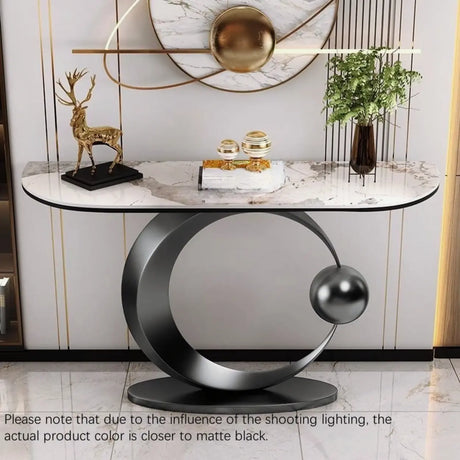
These pieces use the base as a design feature. Curved slabs, rings, crossed frames, and abstract supports can make the table a focal point even with minimal decoration. Because the base carries strong visual weight, the top often looks best with fewer, larger accessories.
Choosing the Right Console Table Material
Wood
Wood brings warmth and works across rustic, Scandinavian, traditional, and modern rooms. Because resistance to scratches, moisture, and heat varies by finish, follow the product’s care instructions and use trays or coasters when needed.
Stone and sintered stone
Stone creates a polished, substantial look. Sintered stone offers stone-like patterns in a manufactured material. Confirm the furniture weight and delivery path, and do not assume every stone surface has identical stain or scratch resistance.
Metal
Metal frames can look slim while creating strong geometric structure. Black suits industrial and minimalist rooms, while gold-tone finishes add a decorative accent. Check joints, floor contact points, and stability.
Glass, acrylic, and mixed materials
Glass and clear acrylic reduce visual bulk. Mixed designs combine wood or stone tops with metal bases for contrast. Transparent materials reveal fingerprints and the wall behind them, so plan for regular cleaning.
How to Choose the Right Console Table
1. Decide what the table must do
Start with a verb: display, store, light, divide, serve, or work. If the goal is to catch keys, you may need a tray and one shallow drawer. If the goal is to anchor large artwork, an open sculptural design may be better. If the goal is dining-room storage, a cabinet-style piece or sideboard may be the more honest solution.
2. Choose dimensions for circulation
A beautiful table becomes inconvenient if it narrows a route. Use the measuring method above and prioritize depth in hallways. For behind-sofa placement, prioritize height and length. In an entryway, also consider the swing of the front door and the space needed to remove shoes or greet guests.
3. Match visual weight to the room
Open metal legs and transparent materials feel lighter; solid pedestals, stone tops, dark finishes, and cabinets feel heavier. Match that visual weight to the scale of the wall and room.
4. Balance storage and openness
Storage solves real problems, but it also changes the silhouette. Drawers add discreet organization with relatively little bulk. Shelves create display capacity but require styling. Cabinets hide more objects but may feel closer to a sideboard. Choose only the storage you will use rather than maximizing compartments automatically.
5. Consider the objects placed on top
A lamp needs enough surface area and access to an outlet. A large mirror or artwork needs proportional support below it. Stoneware, plants, and books add weight. Check the table’s stated materials, construction, and load guidance; do not treat a decorative console as seating or a step.
6. Check assembly and stability
Review whether assembly is required and whether the table includes wall-anchoring hardware. Long, narrow furniture can be vulnerable to tipping if climbed on, pulled, or unevenly loaded. Follow the manufacturer’s installation instructions, use suitable wall anchors for the wall type, and keep children from climbing drawers or shelves.
7. Select a finish that belongs in the whole room
The console does not have to match every finish. It should repeat or complement at least one element—wood tone, metal color, stone pattern, upholstery, or architectural detail. Intentional contrast often looks better than a near-match that is slightly wrong.
How to Style a Console Table Without Clutter
A console table is often viewed from a distance, so a few clear shapes usually work better than many tiny objects. Build the arrangement around function first, then use height, mass, texture, and negative space to create balance.
Start with one visual anchor
Hang or lean a mirror, framed artwork, or a small grouped arrangement above the table. As a starting point, the visual anchor can span roughly one-half to two-thirds of the table width. Adjust for the shape of the wall and the visual weight of the frame rather than following the ratio mechanically.
Create three height levels
Use one tall element, one medium element, and one low element. For example, combine a lamp, a vase or framed photograph, and a shallow tray with stacked books. The differences in height help the eye move through the arrangement without requiring many accessories.
Keep a practical landing zone
In an entryway, leave part of the tabletop empty. A beautiful arrangement that occupies every inch removes the table’s everyday usefulness. A tray can define where keys belong, while a drawer can keep mail and cords out of sight.
Use asymmetry carefully
Place a tall lamp or branch arrangement on one side and balance it with a lower, wider group on the other. The objects do not need to match; their visual weight should feel stable. On a sculptural console, allow the base to remain the star by reducing the number of objects above it.
Style the lower shelf as one composition
Instead of filling every gap, use one or two substantial baskets, a short stack of books, or a large ceramic vessel. Repeated small accessories can look busy and collect dust. Leave open space so the shelf and floor remain visible.
Adjust styling for a sofa table
Accessories behind a sofa should look finished from more than one direction. Hide cords, avoid unfinished frame backs, and keep fragile tall objects away from areas where someone may reach over the upholstery. If the sofa table sits between the living and dining zones, use restrained styling so it does not create a visual barrier.
Common Console Table Mistakes to Avoid
Choosing a table that is too deep
This is the most common error in a hallway or small foyer. A few extra inches can turn an easy passage into an obstacle. Tape the full footprint on the floor and test the route before buying.
Ignoring the sofa-back height
A standard console height is not automatically correct behind every sofa. Measure the actual upholstery and back cushions, then compare the product’s overall height. Keep lamp scale and sightlines in mind as well.
Buying for appearance without a purpose
If you need concealed storage, an open pedestal table may lead to clutter elsewhere. If you only need a sculptural focal point, a drawer-heavy cabinet may feel unnecessarily bulky. Define the job before choosing the style.
Using too many small accessories
Numerous small objects weaken the focal point and make the surface harder to use. Edit the arrangement into a few groups, vary their height, and preserve negative space.
Forgetting cords and outlets
Plan lamp and charging-cable routes before placing the table. Do not pinch cords behind the furniture or block vents. If a visible outlet will sit above the tabletop, include it in your height and styling plan.
Skipping stability precautions
A narrow table may look stable but still tip when a drawer is pulled, a child climbs, or weight is concentrated at the edge. Assemble the piece correctly, level it, and use appropriate anti-tip anchoring whenever the manufacturer recommends it.
Recommended Homebaa Collections and Console Tables
The right console depends on where it will go and what it must hold. The following collections provide different ways to browse, followed by three product examples chosen for narrow-space display, organized storage, and sculptural entryway styling. Each image and destination link appears once.
Homebaa Collections to Explore

Console Tables
Compare narrow wood tables, stone tops, half-moon silhouettes, storage designs, and sculptural bases intended for entryways, hallways, and living rooms.
Browse Console Tables
Entry Furniture
Explore console tables alongside benches, coat racks, shoe storage, and other pieces that help create a more useful and organized entrance.
Browse Entry Furniture
Tables
Use this broader collection to compare console tables with coffee, dining, side, and bar tables when planning the proportions of a complete room.
Browse All Table TypesProduct Picks for Different Console Table Needs

Rustic Natural Rectangular Wood Entryway Console Table
A strong option for narrow-space display, this natural wood model is 11 inches deep and approximately 35.5 inches high. It comes in 47-, 55-, and 63-inch lengths and uses a storage-free double-pedestal design.
View This Narrow Console
Black Metal Rectangular Console Table with Drawers
Choose this design when entryway organization matters. It combines a stone top, metal frame, and two drawers, with a depth of about 14 inches and several lengths for small through long wall spaces.
View This Storage Console
Entryway Decorative Half Moon Sintered Stone Console Table
The flat-back, curved-front shape suits an entry or hallway that needs a softer silhouette. It measures about 12 inches deep and 31.5 inches high, with multiple lengths and black, white, or gold base choices.
View This Half-Moon ConsoleFinal Buying Checklist
Before choosing a console table, confirm these details:
- Purpose: Decide whether the table must display, store, light, divide, serve, or support occasional work.
- Depth: Mark the footprint and preserve comfortable walking and door clearance.
- Height: Relate it to the sofa back, wall art, mirror, windows, switches, and planned accessories.
- Length: Leave visual breathing room and choose a proportion that suits the wall or sofa.
- Storage: Select drawers, shelves, or cabinets only when they solve a real organization need.
- Material: Consider cleaning, weight, finish variation, and the objects that will sit on top.
- Safety: Review assembly, load guidance, leveling, and anti-tip anchoring instructions.
- Delivery: Check doors, stairs, elevators, corners, and the final installation route.
A well-chosen console table should make an underused area easier to live with. Measure first, choose the function, and then select the shape and finish that make the room feel complete.
Explore Homebaa FurnitureFAQ: Console Table Meaning, Size, and Placement
What is a console table?
A console table is a relatively long, narrow accent table commonly placed against a wall, in an entryway or hallway, or behind a sofa. It provides a raised surface for décor, lighting, and everyday essentials, and it may include drawers, shelves, or cabinets.
What is a console table used for?
Console tables are used as entryway landing zones, hallway displays, behind-sofa surfaces, decorative living-room anchors, or compact serving areas. Depending on the design, they can hold keys, mail, lamps, mirrors, artwork, books, baskets, and other small household items.
Why is it called a console table?
The name is associated with early tables supported by wall brackets or architectural consoles. Modern console tables are usually freestanding, but they retain the slim proportions and wall-side placement associated with the earlier furniture form.
What is the standard height of a console table?
Many console tables are approximately 28 to 36 inches high, but there is no single required height. For wall placement, consider nearby artwork and windows. Behind a sofa, choose a height that is level with or slightly below the practical sofa-back height.
How deep should a console table be for a narrow hallway?
A depth of about 10 to 12 inches is often useful in a narrow hallway, provided it leaves comfortable walking clearance. Mark the full footprint with painter’s tape and test nearby doors and traffic before choosing a specific depth.
Can a console table go behind a sofa?
Yes. A console table used behind a sofa is often called a sofa table. Compare its height with the sofa back, choose a balanced length, keep the depth appropriate for the available floor space, and plan how lamp or charging cords will be concealed.
What is the difference between a console table and a sideboard?
A console table is usually slimmer and may have an open base or light storage. A sideboard is generally deeper and cabinet-based, providing more enclosed storage for dishes, linens, media, or other household items.
Can a console table be used as a desk?
A console can serve as an occasional writing or laptop surface if its height, depth, stability, and legroom are comfortable. Many decorative consoles are too shallow for ergonomic daily work, so measure the chair, equipment, and knee clearance first.
What should I put on a console table?
Start with one visual anchor such as a mirror or artwork, then add a tall object, a medium-height object, and a low tray or book stack. In an entryway, preserve an empty landing area for keys, mail, or bags rather than covering the entire surface.
Should a console table be attached to the wall?
Follow the manufacturer’s safety and installation instructions. Because console tables are often tall and narrow, anti-tip anchoring may be recommended, especially in homes with children or where drawers, doors, or uneven loads could affect stability.
Can a console table be wider than the mirror above it?
Yes. In many balanced arrangements, the mirror or artwork is narrower than the console table. A useful starting point is an anchor around one-half to two-thirds of the table width, but wall proportions, frame shape, and visual weight should guide the final choice.
Is a half-moon table a console table?
Yes. A half-moon or demilune table is a type of console with a flat back and curved front. It sits against a wall and can be especially useful when you want a softer silhouette or less prominent corners in an entryway.